Insurance and Safety — Mowing Sucks
 Mowing Sucks takes a proactive approach to safety and insurance so every job is delivered with professional care. This page outlines our public liability insurance cover, our staff training standards, the personal protective equipment (PPE) we use, and the risk assessment process that underpins every site visit. Whether you call us Mowing Sucks or refer to our team as mowing sucks, our commitment to reducing risk and protecting people and property is consistent.
Public Liability Insurance Coverage
Our public liability insurance is structured to provide clear protection for third-party property damage and bodily injury arising from our operations. We maintain comprehensive cover, including legal costs and third-party claims, to ensure that customers and the community are safeguarded when our crews are on site. The insurance policy applies to a wide range of scenarios encountered by a professional lawn and grounds maintenance service, and our operational limits are reviewed regularly to match the scale and complexity of the work we undertake.
 Key features of our liability framework include:
- Coverage for accidental property damage and personal injury caused by our activities
- Legal and claims management support to speed resolution
- Appropriate limits tailored to commercial and domestic contracts
The mowing-sucks team undergoes an induction process and ongoing training designed to reinforce safe working practices and compliance with insurance conditions. Training is not a one-off event; it is a continuous program that balances technical skills with an emphasis on hazard recognition and avoidance. Staff competency is assessed regularly and documented to demonstrate that every crew member meets the standards expected for safe machinery operation and site management.
 Staff training modules include, but are not limited to:
- Safe operation of mowers, trimmers, and powered equipment
- Manual handling and ergonomic lifting techniques
- First aid and incident response tailored to outdoor work
- Environmental awareness and protection of sensitive areas
We pair classroom learning with practical, supervised experience. Supervisors conduct on-the-job observations and sign-offs; refresher courses are scheduled when new equipment is introduced or when a gap in performance is identified. All training records are maintained centrally and are available for review as part of our internal audits and insurance compliance checks.
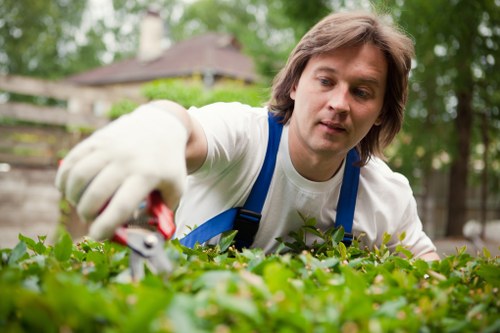
PPE is selected to meet the hazards identified during risk assessments and to comply with best practice standards. Typical items issued to our crew include high-visibility clothing, protective footwear, hearing protection, eye protection, and cut-resistant gloves. Equipment-specific PPE—such as chainsaw chaps or face shields—is supplied where tasks require additional safeguards. We emphasize proper fit, correct use, and routine inspection of PPE, and damaged items are replaced immediately to maintain protection levels.
Risk Assessment Process
![A gardener wearing a light blue long-sleeved shirt and bright orange gloves is trimming pink flowering bushes in a well-maintained garden. The garden features a lush, evenly mowed lawn with dense, green grass in the foreground and a neatly trimmed bush on the right side. In the background, there are tall trees and a variety of shrubs, contributing to a landscaped outdoor space typical of gardens in the South East UK, such as around infer from postcode data. The scene is set in natural daylight, suggesting a clear, mild weather day suitable for outdoor gardening activities. The gardener's focus on precise pruning indicates careful maintenance of garden elements, aligning with professional landscaping and gardening services provided by companies like Mowing Sucks, who operate in local areas such as [TOWN] and the surrounding postcode zones. This scene exemplifies routine garden upkeep, emphasizing the importance of hedge trimming and flower bed care for a tidy and attractive outdoor environment.](/pub/_photos/gardening/f1988703848.jpg) Our risk assessment process is systematic and documented to ensure consistency across all sites. The core steps are:
Our risk assessment process is systematic and documented to ensure consistency across all sites. The core steps are:
- Pre-visit review: examine site history, access, and any previous incident reports
- On-site hazard identification: locate physical hazards, utility lines, pedestrians, animals and environmental sensitivities
- Risk evaluation: assess the likelihood and potential severity of identified hazards
- Control measures: implement elimination, substitution, engineering, administrative controls or PPE as appropriate
- Documentation: record findings, required controls and responsible persons
- Dynamic reassessment: update controls in response to changing site conditions
 The assessment results are translated into a clear action plan for the crew and the client, detailing specific controls, exclusion zones, and safe systems of work. This ensures that every job has a documented safety strategy that aligns with our insurance obligations and operational standards. For higher-risk activities we apply additional measures such as permit-to-work systems, traffic management plans and exclusion fencing to keep bystanders safe.
Incident reporting and continuous improvement are central to our approach. All incidents, near misses and safety observations are reported, investigated and used to refine our procedures. Findings feed back into training updates and risk assessment templates so lessons learned are quickly shared across the MOWING SUCKS workforce. This closed-loop approach reduces repeat occurrences and strengthens our position with insurers.
We maintain records for audits and insurance reviews, demonstrating the practical application of controls and the effectiveness of our systems. Audits include checks on PPE condition, training currency, site documentation and insurance certificates. Where gaps are identified, corrective actions are logged with target completion dates and verification steps to ensure accountability.
In summary, whether you call the service mowing sucks, MowingSucks or any other variation, our safety and insurance framework is robust: public liability cover, comprehensive staff training, appropriate PPE and a rigorous risk assessment process work together to protect people, property and the environment. We continually review and enhance these systems to meet evolving standards and to keep our operations both safe and fully insured.